Is AI actually safer than relying on human judgment alone, or just faster? It’s a question that’s increasingly being asked as AI becomes more widely adopted in mass claims. Recent discussions among legal and technology experts explored the practical considerations, challenges, and opportunities presented when using AI to manage international cross-border mass claims. Here’s what they had to say.
The human-only vs AI debate doesn’t reflect the reality of legal work
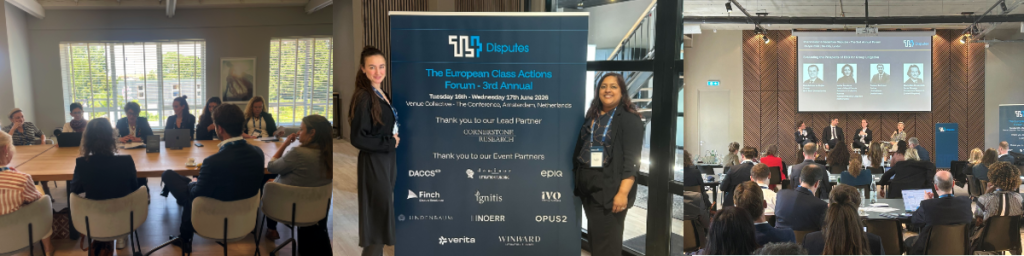
During a roundtable on managing international cross-border mass claims at The European Class Actions Forum, Caroline Zand-Korteweg, Director of AI & Market Development at Opus 2, challenged the common assumption that human-only processes should automatically be treated as the benchmark for accuracy: “Is it per se worse to have AI help you out, or to maybe flag if it wasn’t sure, and have you review the ones that you’re unsure of?”
It’s a fair point worth consideration. Anyone who has worked on large-scale, document-heavy cases knows the comfortable answer isn’t the honest one. Late in the evening, tired, reviewing the thousandth document that looks like the nine hundred and ninety-ninth, that’s not a process immune from error either. The more valuable and realistic comparison isn’t AI versus a perfect human reviewer. It’s AI versus a human working under real-world conditions—long hours, mounting pressure, and the toll both take on a tired pair of eyes.
The real question is verification, not adoption
Much of the debate around AI in mass claims still asks whether teams should adopt it at all. The panel had moved past that. For them, adoption was settled—the open question was how well AI’s flags get checked once it’s used. One practitioner on the panel who works on the defence side of mass litigation agreed: AI “can flag certain things it sees,” with the caveat that this “doesn’t mean it’s always right, but at least it can flag things.” The conclusion wasn’t “trust the AI” or “don’t trust the AI,” it was that AI’s flagging and human review should always work together: the same multi-stage verification process good teams already use with human-only input, just with AI doing first-pass triage rather than a person doing it cold. As the same speaker put it bluntly, get the verification wrong, and “you’ll get killed in court.”
That’s a meaningfully different framing from how this debate usually gets pitched. It isn’t about whether AI replaces a lawyer’s judgment. It’s about where in the process human judgment is best spent: on flagging everything from scratch, or on reviewing what’s been flagged as uncertain.
Digital infrastructure matters as much as AI
One of the biggest barriers to AI adoption in mass claims, isn’t really about AI at all. It is about how unevenly digitised the surrounding infrastructure still is. In some jurisdictions, the tools being piloted for claims processing are, in practitioners’ own words, not very reliable yet, leading teams to fall back on manual processes even when a tool exists. Judiciaries handling mass claims in some countries are, by one account, overwhelmed by the volume, with decisions taking months or even years in some cases with no tooling to help manage it.
This matters because it reframes what AI adoption actually requires. The technology question is often the easy part. The harder part is whether the courts, the claims administrators, and the case management processes around the technology are mature enough to make use of it, and that varies enormously across Europe, let alone globally.
AI presents opportunities for junior lawyers
For junior lawyers working on CAT cases, AI can increase their visibility and value to the team. Increasingly, the practical reality is that they are the person in the room who actually understands how the AI works and how it can be applied to the case. This theme surfaced during a panel co-hosted by Hausfeld and Opus 2 at London International Disputes Week.
The experts, including Roo Patel, Director of Commercial Operations at Opus 2, agreed that there’s a particular kind of value in being able to walk into a case, understand a platform a senior partner doesn’t have time to learn. Junior lawyers can bring that knowledge to bear, effectively saying, here’s something I’ve learned, here’s how it speeds things up, and here’s why it’ll work well for this case. That’s not a small thing for a junior lawyer’s standing on a matter. But it came with an explicit caution too: a fantastic tool is still a tool, and there’s a real risk in not staying conscious of where AI’s reasoning might not have gone through the same scrutiny a person’s would.
That tension, genuine enthusiasm for what the technology enables, paired with a refusal to switch off scepticism, is probably the healthiest place for the profession to sit right now. Not uncritical adoption. Not reflexive resistance. Active, ongoing verification, the same way any junior lawyer is taught to check their own first drafts.

What this means in practice
Taken together, these insights from mass claims and technology experts point to a fairly consistent picture of where AI actually earns its place in disputes right now: not as a replacement for judgment, but as a way of making sure tired, overloaded humans aren’t the only check in the system. The mass claims environment, with thousands of documents, jurisdictions at wildly different levels of digital maturity, and judiciaries under real strain, is exactly the kind of environment where that matters most.
It’s also the principle we’ve built Opus 2’s AI for lawyers around. Our platform doesn’t ask teams to choose between AI and human judgment; it combines AI-driven analysis with experienced human oversight, so the flagging happens automatically and the verification still happens deliberately. That’s the same multi-stage thinking practitioners described building themselves, case by case, applied as standard. We’ll keep showing up to these conversations because the practitioners managing complex mass claims while navigating AI adoption are best placed to identify challenges and opportunities, and that’s exactly the input that shapes what we build next.
Opus 2 has supported dispute resolution teams for over 15 years, combining AI-driven analysis with experienced human oversight across preparation, hearings, and the full lifecycle of a case. Find out more at opus2.com/hearings.