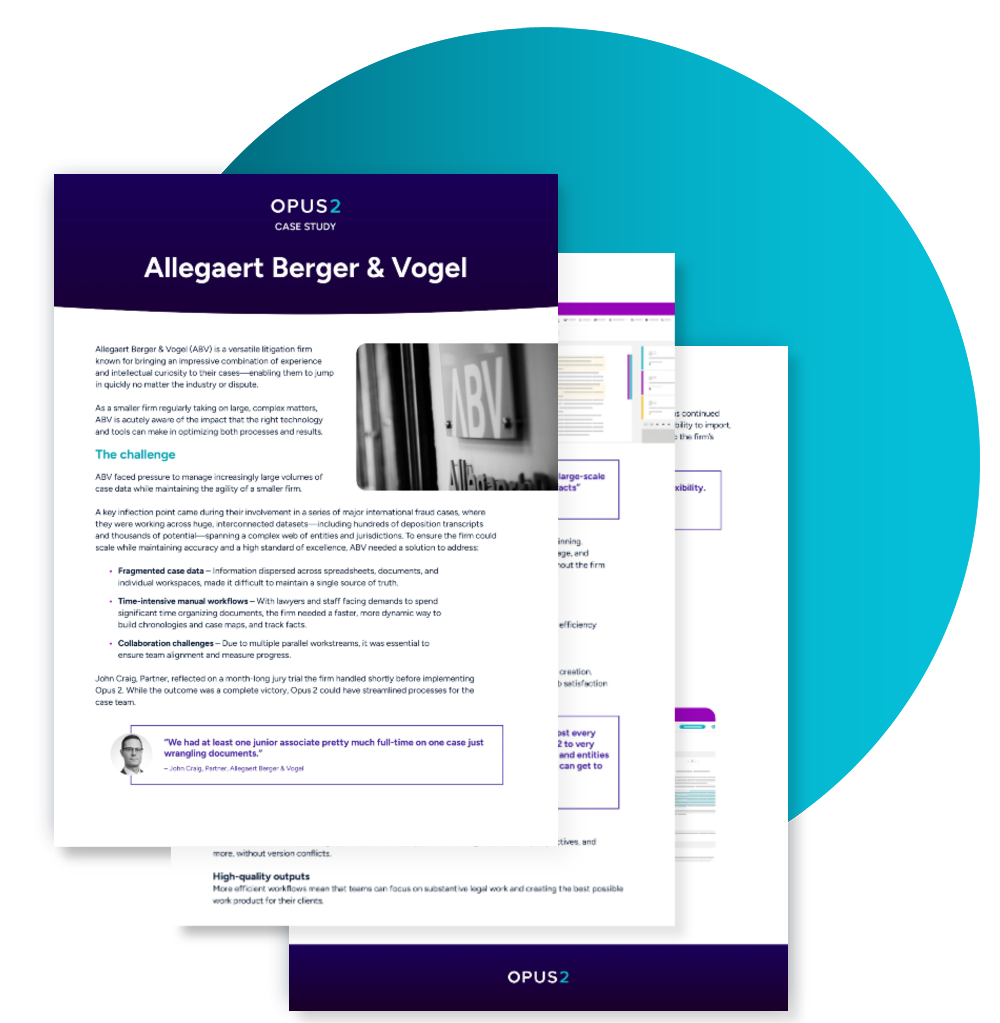
Case study: Allegaert Berger & Vogel
Allegaert Berger & Vogel (ABV) is a versatile litigation firm known for bringing an impressive combination of experience and intellectual curiosity to their cases—enabling them to jump in quickly no matter the industry or dispute.
As a smaller firm regularly taking on large, complex matters, ABV is acutely aware of the impact that the right technology and tools can make in optimizing both processes and results.
Challenge
ABV faced pressure to manage increasingly large volumes of case data while maintaining the agility of a smaller firm. A key inflection point came during their involvement in a series of major international fraud cases, where they were working across huge, interconnected datasets—including hundreds of deposition transcripts and thousands of potential—spanning a complex web of entities and jurisdictions. To ensure the firm could scale while maintaining accuracy and a high standard of excellence, ABV needed a solution to address:
- Fragmented case data – Information dispersed across spreadsheets, documents, and individual workspaces, made it difficult to maintain a single source of truth.
- Time-intensive manual workflows – With lawyers and staff facing demands to spend significant time organizing documents, the firm needed a faster, more dynamic way to build chronologies and case maps, and track facts.
- Collaboration challenges – Due to multiple parallel workstreams, it was essential to ensure team alignment and measure progress.
John Craig, Partner, reflected on a month-long jury trial the firm handled shortly before implementing Opus 2. While the outcome was a complete victory, Opus 2 could have streamlined processes for the case team. He noted, “We had at least one junior associate pretty much full-time on one case, just wrangling documents.”
Solution
ABV selected Opus 2 to centralize case management and enhance the structure of their workflows. The partnership delivered:
- A unified platform for all key case data, including robust document organization with the ability to sort, filter, and create virtual binders.
- Centralized case mapping and chronology building, allowing users to link entities, facts, and events.
- A shared collaborative workspace where users can identify and link facts, add designations and annotations, and compare analysis.
“We’ve been most impressed by how Opus 2 allows us to create a large-scale case map and chronology and also go deeper into client-specific facts.” – David Shaiman, Partner
The firm collaborated with Opus 2 to plan for and facilitate rapid adoption from the very beginning. By offering dedicated training support staff, leveraging internal power users to champion usage, and systematically expanding usage across matters, Opus 2 was able to scale organically throughout the firm while delivering value from the start.
Value delivered
ABV fundamentally changed how their teams manage litigation with Opus 2, delivering both efficiency gains and qualitative improvements to how work gets done.
ABV was able to eliminate hours of manual effort with workflows like automated chronology creation. Improved document and fact organization increased efficiency further, and drove greater job satisfaction within the team.
“What we do is very, very document intensive. On some level, almost every argument depends on exactly what a document says,” said Michael Vogel, Partner. “Using Opus 2 to very quickly access the relevant documents and connect them to facts and entities within the case saves a lot of wasted time and wheel spinning. We can get to work of substance much more effectively.”
Teams can work simultaneously within a central workspace to add insights, compare perspectives, and more, without version conflicts.
More efficient workflows mean that teams can focus on substantive legal work and creating the best possible work product for their clients.
Continued partnership
While the catalyst for adding Opus 2 was a single instance of large-scale litigation, Opus 2 has continued to show value across a wide range of cases. With flexible data management—including the ability to import, export, and manipulate structured data to adapt to existing workflows—it fits seamlessly into the firm’s workflows and has become an integral part of the firm’s competitive edge.
“One of the things that impressed us from day one was Opus 2’s flexibility. And getting to know the product more, it continues to impress us.” – John Craig, Partner
Allegaert Berger & Vogel