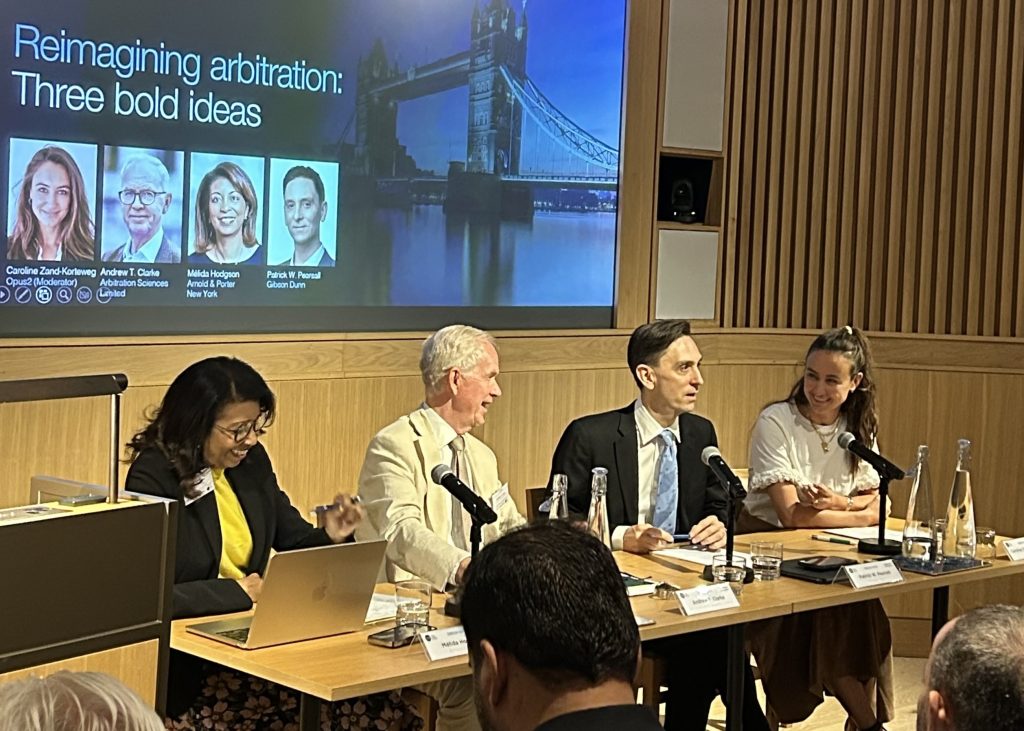
I moderated a session at LIDW this year called Reimagining Arbitration: Three Bold Ideas. My job was to ask the questions, not answer them. So I did what moderators do – kept things moving, stayed neutral, and sat on everything I actually wanted to say.
It wasn’t easy.
The session presented three genuinely bold proposals. Mélida Hodgson, partner at Arnold & Porter and President of the American Society of International Law, made the most urgent case I’ve heard in years for institutions to sanction counsel misconduct—not eventually, not through a lengthy code of conduct, but now. Andrew Clarke, founder of Arbitration Sciences and former General Counsel at ExxonMobil, challenged something arbitration has almost entirely ignored: the science of how decisions are actually made. Both deserve their own piece.
But it was Patrick Pearsall’s proposal I haven’t been able to shake. Patrick is a partner at Gibson Dunn, former Chief of Investment Arbitration at the US Department of State, and the principal architect of Ukraine’s Register of Damages someone with a rare instinct for what is both bold and actually doable. And given my background as a litigation lawyer having spent years advising clients on whether to fight, then as a founder building AI tools for litigation lawyers, I’m not a neutral observer.
So here is what I actually wanted to say in the room.
The case for mandatory AI assessment
The idea is deceptively simple: “Build in a mandatory precondition to arbitration requiring each party to run its case through a joint AI-driven strengths and weaknesses assessment.” And it’s no half-measure: “Not a soft suggestion… not a best efforts obligation, but a condition precedent.” Both sides run their case through the same independent system, producing a confidential, non-binding, probability-weighted report, before a notice of arbitration can be served.
Not an oracle. Not a verdict. A structured, evidence-based reality check, built into the process at the point where it would do the most good.
As someone who spent years sitting across from clients deciding whether to pursue a dispute, I felt this immediately. The hardest conversation in litigation isn’t the legal argument—it’s the honest one at the start, before the meters are running and before positions have hardened. What does this case actually look like from the outside? What are the realistic odds? What would it cost to find out?
Those conversations are too often shaped by overconfidence, incomplete information, and the uncomfortable tension between what a client wants to hear and what they need to hear. An independent assessment wouldn’t eliminate that tension. But it would give both sides something solid to anchor to, something that didn’t come from their own lawyer.
Taking the idea one step further to continuous AI assessment
There’s an important distinction at the heart of this: “We are not talking about an oracle. Prediction, as such, with certainty, is a misnomer.” It’s about probability-weighted assessment based on historical patterns.
But I’d go one step further than pre-dispute assessment alone. What excites me most is the idea that the same capability could run continuously through a case—recalibrating as new facts emerge, as procedural decisions are made, as you learn more about how a particular arbitrator has ruled in comparable situations.
Run the same case through different arbitrators and watch the output change. That’s not a side feature. Having spent the last few years building AI for exactly this kind of legal context, I can tell you: that is transformative.
The data problem is real—here’s why it shouldn’t matter
The most common objection in the room was data. Arbitration is notoriously opaque compared to litigation. You can’t train a model on decisions that were never published.
Fair. But it’s not a reason not to try. The data landscape is improving. Institutions are publishing more. The models are getting better at reasoning from limited information. Objections like ‘the data isn’t good enough,’ ‘the edge cases are too complex,’ or ‘the context is too specific’ are real, but in my experience, these are reasons to build carefully rather than reasons not to build at all.
The question isn’t whether the data is perfect today. It’s whether we start building the infrastructure now or wait until it is and lose another five years.
The lawyers who fear this proposal are thinking about it wrong
The fear is simple: if a piece of software can size up a case before a lawyer even gets involved, what’s left for the lawyer to do? It’s the same argument that was made against mandatory mediation tiers in the 1970s. Arbitration has grown since then, not shrunk.
The argument that mandatory AI assessment reduces business for lawyers misses something important—and as a former lawyer, I want to say this plainly. A lawyer who comes to a client at the outset with an honest, data-driven view of their chances isn’t a lawyer who loses business. That’s a lawyer who becomes genuinely trusted. And a client who trusts their lawyer on the hard call at the start of a dispute is a client who comes back, who refers, who deepens the relationship far beyond the single matter.
The financial upside isn’t smaller in this world. It’s just different. And arguably much larger.
This isn’t just bold—it’s overdue
Patrick ended with a challenge: move AI case assessment from something sophisticated parties already do privately and asymmetrically, to a procedural step that both sides complete before spending two years and two million dollars.
It’s the right challenge. And one I feel personally.
I’ve sat across from clients deciding whether to fight. I’ve built tools to help lawyers work more effectively and efficiently. From both sides of that table, I can tell you: the information advantage already exists. The best-resourced parties are already using predictive tools, already walking into disputes with a clearer picture of the odds than the other side has. That’s not a future risk. That’s a Tuesday.
AI hasn’t just entered arbitration. It’s already there—quietly, unevenly, and in favour of whoever could afford it first.
What Patrick is proposing is simple: make it fair. Turn a private advantage into a shared one. Give both sides the same honest picture before anyone commits to the years and the money.
The technology is there. The cost case is overwhelming. The drafting framework exists. The only thing standing between where we are and where we should be, is a decision.
Mandatory AI assessment – FAQ
What is mandatory AI case assessment in arbitration?
A proposal that would require both parties to run their case through an independent AI-driven strengths-and-weaknesses analysis before filing for arbitration. The output is a confidential, non-binding report—not a verdict. The goal is to deter weak claims, accelerate settlement, and narrow the issues for cases that do proceed.
Is AI already being used in international arbitration?
Yes. The 2025 Queen Mary survey found that 90% of practitioners expect to use AI for research, data analytics and document review over the next five years. Use cases for AI in arbitration including disclosure and summarisation are already widespread. The more sophisticated, legally specific applications like predictive analytics and case strategy are still emerging.
What is the biggest barrier to AI adoption in arbitration?
Culture, not technology or regulation. Most practitioners are comfortable with AI for standard tasks. Resistance comes when AI gets anywhere near decision-making. Changing that will require institutions to lead, not wait for individual practitioners to move first.
What is Opus 2’s role in this?
Opus 2 has been at the heart of international dispute resolution for over 15 years. Our platform supports legal teams from the earliest stages of case preparation right through to final award—connecting documents, people, and proceedings in one secure environment. Our AI capabilities are built specifically for legal work: summarising daily transcripts, querying witness statements, surfacing connections across large document sets. We’re not just watching this space evolve. We’re helping to shape it. Find out more at opus2.com/hearings.

About the author
Caroline Korteweg is Director of AI & Market Development, Europe at Opus 2. A former litigation lawyer, she co-founded Uncover, a legal AI company, in 2022 to solve the problems she’d lived in practice—building AI tools that help legal teams organise cases, surface insights, and cut through document complexity. Opus 2 acquired Uncover in 2025, bringing those capabilities into a platform that has been at the centre of international dispute resolution for over 15 years, trusted by the world’s leading law firms to run their most complex cases—from first document to final award.