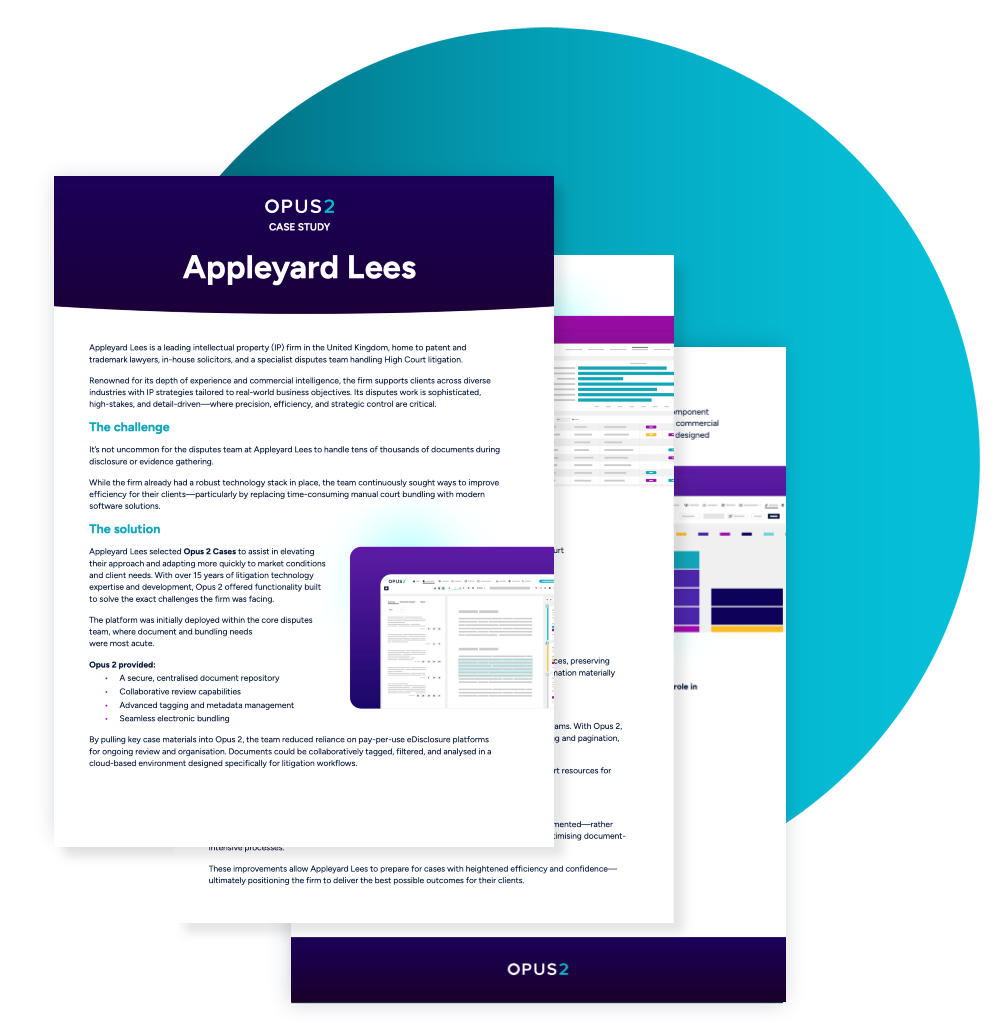
Opus 2 case study: Appleyard Lees
Appleyard Lees is a leading intellectual property (IP) firm in the United Kingdom, home to patent and trademark lawyers, in-house solicitors, and a specialist disputes team handling High Court litigation.
Renowned for its depth of experience and commercial intelligence, the firm supports clients across diverse industries with IP strategies tailored to real-world business objectives. Its disputes work is sophisticated, high-stakes, and detail-driven—where precision, efficiency, and strategic control are critical.
The challenge
It’s not uncommon for the disputes team at Appleyard Lees to handle tens of thousands of documents during disclosure or evidence gathering.
While the firm already had a robust technology stack in place, the team continuously sought ways to improve efficiency for their clients—particularly by replacing time-consuming manual court bundling with modern software solutions.
The solution
Appleyard Lees selected Opus 2 Cases to assist in elevating their approach and adapting more quickly to market conditions and client needs. With over 15 years of litigation technology expertise and development, Opus 2 offered functionality built to solve the exact challenges the firm was facing.
The platform was initially deployed within the core disputes team, where document and bundling needs were most acute.
Opus 2 provided:
- A secure, centralised document repository
- Collaborative review capabilities
- Advanced tagging and metadata management
- Seamless electronic bundling
By pulling key case materials into Opus 2, the team reduced reliance on pay-per-use eDisclosure platforms for ongoing review and organisation. Documents could be collaboratively tagged, filtered, and analysed in a cloud-based environment designed specifically for litigation workflows.
The results
Appleyard Lees quickly transformed their document review and bundling workflows.
Improved oversight in large-scale document review
With disclosure exercises involving tens of thousands of documents, visibility and control are paramount.
Opus 2 enabled multiple team members, including external counsel, to review, annotate, and organise materials within the same live environment—significantly reducing duplication and improving consistency. The ultimate results? Higher confidence in review quality and stronger command of case materials.
Appleyard Lees